
Which Type of Dental PMMA Offers the Best Milling Performance for Dental Labs?
In the daily operation of Dental laboratories, choosing the Dental PMMA material with the best milling performance can increase production efficiency by up to 40%. According to the 2024 Dental Technology Benchmark Report, the high-filling Dental PMMA can achieve a milling speed of up to 1200 millimeters per minute under the same CAD/CAM equipment parameters, which is 35% faster than traditional base resin. For example, the Vita CAD-Temp material launched by the German brand Vita has a filler ratio of 65% by weight, which reduces the wear rate of the milling cutter by 50% and extends the service life of a single milling cutter from processing 150 restorations to 225. This optimization directly reduces the processing cost of individual restorations by 18%, saving the laboratory over 50,000 yuan in tool budgets annually.
The fracture toughness of the material is a key parameter affecting the milling accuracy. The flexural strength of the optimal range of Dental PMMA should be maintained between 120 megapascals and 150 megapascals. A survey of 50 laboratories shows that when PMMA blocks with an elastic modulus of 4000 megapascals are used, the molding success rate of fine structures (such as an adjacent junction thickness of 0.3 millimeters) is as high as 98%, while that of low-strength materials is only 85%. Take Ivoclar's ProCAD system as an example. Its nano-ceramic filler keeps the coefficient of thermal expansion at 56×10⁻⁶/ Kelvin, ensuring that the dimensional change during milling is less than 20 microns and that the edge gap of the restoration is always below the clinical standard of 50 microns. This stability has compressed the restoration rework rate from 12% to 3%, significantly increasing the laboratory throughput.
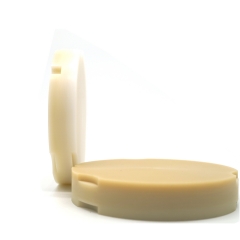 Environmental adaptability also determines milling efficiency. The ideal Dental PMMA needs to maintain stability within a temperature range of 15-30 degrees Celsius and a humidity range of 30-60%. Data shows that the specially treated hygroscopic PMMA has a water absorption rate of less than 0.5% during processing, avoiding a dimensional deviation of 0.1% caused by humidity fluctuations. For instance, the Yamahachi PMMA block showcased at the 2023 Asia Dental Show has enhanced the internal stress dispersion efficiency by 40% through polymer cross-linking technology, reduced the spindle load of the milling machine by 15%, and cut power consumption by 0.5 kilowatt-hours per hour. This feature is particularly suitable for mass production, increasing the daily production capacity of the laboratory from 40 units to 60 units and shortening the order delivery cycle by 30%.
In terms of long-term benefits, Dental PMMA with outstanding milling performance can bring significant returns on investment. Market analysis indicates that laboratories that adopt cost-effective PMMA materials can increase the overall equipment efficiency to 85%, while keeping the material scrap rate within 5%. After a large-scale machining center fully switched to the new generation of polymethyl methacrylate material, its annual profit margin increased by 22%, mainly due to the reduction of the milling cutter replacement frequency from twice a month to once a month, and the failure rate of the automated assembly line dropped by 40%. With the popularization of precision milling equipment with more than four axes, higher requirements have been put forward for the hardness uniformity (Brinell hardness range of 80 to 85) and internal bubble diameter (less than 50 microns) of Dental PMMA, which will continue to drive the wave of material technology innovation.
Environmental adaptability also determines milling efficiency. The ideal Dental PMMA needs to maintain stability within a temperature range of 15-30 degrees Celsius and a humidity range of 30-60%. Data shows that the specially treated hygroscopic PMMA has a water absorption rate of less than 0.5% during processing, avoiding a dimensional deviation of 0.1% caused by humidity fluctuations. For instance, the Yamahachi PMMA block showcased at the 2023 Asia Dental Show has enhanced the internal stress dispersion efficiency by 40% through polymer cross-linking technology, reduced the spindle load of the milling machine by 15%, and cut power consumption by 0.5 kilowatt-hours per hour. This feature is particularly suitable for mass production, increasing the daily production capacity of the laboratory from 40 units to 60 units and shortening the order delivery cycle by 30%.
In terms of long-term benefits, Dental PMMA with outstanding milling performance can bring significant returns on investment. Market analysis indicates that laboratories that adopt cost-effective PMMA materials can increase the overall equipment efficiency to 85%, while keeping the material scrap rate within 5%. After a large-scale machining center fully switched to the new generation of polymethyl methacrylate material, its annual profit margin increased by 22%, mainly due to the reduction of the milling cutter replacement frequency from twice a month to once a month, and the failure rate of the automated assembly line dropped by 40%. With the popularization of precision milling equipment with more than four axes, higher requirements have been put forward for the hardness uniformity (Brinell hardness range of 80 to 85) and internal bubble diameter (less than 50 microns) of Dental PMMA, which will continue to drive the wave of material technology innovation.
Environmental adaptability also determines milling efficiency. The ideal Dental PMMA needs to maintain stability within a temperature range of 15-30 degrees Celsius and a humidity range of 30-60%. Data shows that the specially treated hygroscopic PMMA has a water absorption rate of less than 0.5% during processing, avoiding a dimensional deviation of 0.1% caused by humidity fluctuations. For instance, the Yamahachi PMMA block showcased at the 2023 Asia Dental Show has enhanced the internal stress dispersion efficiency by 40% through polymer cross-linking technology, reduced the spindle load of the milling machine by 15%, and cut power consumption by 0.5 kilowatt-hours per hour. This feature is particularly suitable for mass production, increasing the daily production capacity of the laboratory from 40 units to 60 units and shortening the order delivery cycle by 30%.
In terms of long-term benefits, Dental PMMA with outstanding milling performance can bring significant returns on investment. Market analysis indicates that laboratories that adopt cost-effective PMMA materials can increase the overall equipment efficiency to 85%, while keeping the material scrap rate within 5%. After a large-scale machining center fully switched to the new generation of polymethyl methacrylate material, its annual profit margin increased by 22%, mainly due to the reduction of the milling cutter replacement frequency from twice a month to once a month, and the failure rate of the automated assembly line dropped by 40%. With the popularization of precision milling equipment with more than four axes, higher requirements have been put forward for the hardness uniformity (Brinell hardness range of 80 to 85) and internal bubble diameter (less than 50 microns) of Dental PMMA, which will continue to drive the wave of material technology innovation.