
Resin Choices for OSB: MR, E1, E0, PMDI and Phenolic
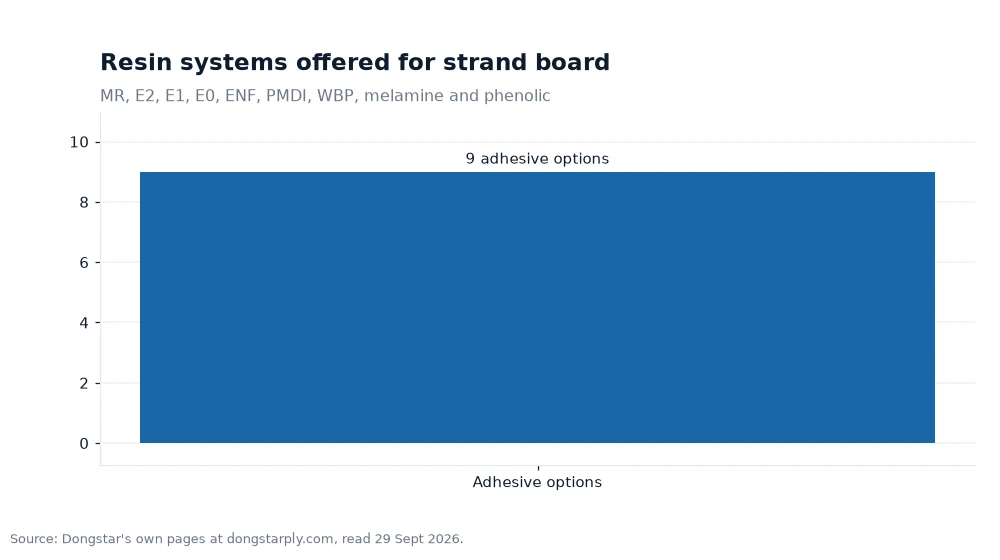
Nine resin systems appear on the strand board datasheet, and they answer three separate questions: how much formaldehyde the finished panel releases, how well it survives moisture, and how much load it will carry. The names to know are MR and the E2, E1, E0 emission classes, plus ENF, PMDI, WBP, melamine and phenolic. The sheets themselves are the same 1220 × 2440 mm format in six thickness steps from 8 mm to 18 mm, so the resin row is what actually separates one quotation from the next.

Key takeaways
- Nine resin systems are published for strand board, and each one belongs to a different problem: emission class, moisture tolerance or load capacity.
- E2, E1 and E0 are formaldehyde release labels in descending order, while ENF is listed as the environment-friendly option.
- PMDI is named for strength and moisture resistance together; WBP and phenolic are the water-resistant systems for outdoor and humid service.
- The panel format stays constant at 1220 × 2440 mm in 8, 9, 11, 12, 15 or 18 mm, so resin and grade carry the technical difference.
Three questions hide behind a single resin name
Resin does more than hold strands together. The systems listed on the page Dongstar keeps for Oriented Strand Board OSB belong to families developed against different regulations and different site conditions, and reading them as one list of alternatives flattens exactly the distinction a buyer needs. Some names describe an emission class; others describe how the bond reacts to water; one describes both at once.
The simplest way to read the row is to sort the names by the question they answer. Emission labels — E2, E1, E0 and ENF — matter to interior use and to the market the finished furniture is sold into. Moisture-oriented systems — MR, WBP, phenolic and melamine — matter wherever panels meet damp air, wet trades or weather. PMDI sits in the middle, because it is described for strength and moisture resistance in the same breath.
The emission ladder from E2 down to ENF
Formaldehyde release is a labelling question, and the published list gives four positions on it. E2 is described as the higher release class of the three emission labels, with E1 and E0 below it, and ENF named as the environment-friendly option. The direction of travel is consistent: each step down the list narrows where the panel can be sold and widens the paperwork a distributor has to hold.
For a buyer shipping into furniture manufacturing, the emission class is usually decided by the destination market rather than by the mill. That makes it worth fixing in writing before the order is placed, because swapping an E class after the panels are pressed is not a shipping adjustment; it is a new production run with a different glue line.
Where PMDI and phenolic earn their place
The page describes PMDI as combining strength with moisture resistance, and WBP or phenolic as water-resistant systems suited to outdoor and humid conditions. Those are the names to reach for when a panel will be exposed during construction, when it sits in a floor that sees weather, or when the finished component lives in a kitchen or a washroom.
Melamine appears on the same list with a different emphasis — moisture tolerance plus a surface that stays presentable — which is why it turns up in furniture and interior work rather than on site hoarding. MR, meanwhile, is described as the value option for interior use. None of these labels is a ranking of quality; each one answers a different question, and a specification that names two of them is usually naming two different panels.
Where the structural class changes the answer
Resin choice cannot be separated from the grade. OSB 3 is the class described for humid conditions and load-bearing duty, with flooring, roof decking, wall sheathing and structural components as its applications, and a structural order that arrives with an interior-grade bond defeats the purpose of specifying the class in the first place.
This is the point where a quotation comparison usually goes wrong. Two suppliers can quote the same thickness in the same format and still be offering different products, because one has priced an interior bond and the other a moisture-resistant system. Asking which resin sits behind the price is a two-word question that resolves the whole comparison.
Matching the list to a real project
Start with the exposure the panel will meet, then the emission rules of the market it will be sold into, then the load it has to carry. Those three answers usually narrow nine published systems down to two or three, and the short list is what belongs in the enquiry. Thickness comes after that, from 8 mm for light lining and packaging work through 12 mm and 15 mm for general fabrication to 18 mm for heavier duty.
Core species finishes the picture. Poplar, pine and eucalyptus are the strands named on the page, and they carry their own differences in weight and density. A panel specification is complete when it names four things: grade, thickness, resin and core species. Anything shorter is an invitation for the mill to make the choice instead.
| Resin system | What the page states | Where it tends to fit |
|---|---|---|
| MR | Value option for interior use | Dry-service interior panels where emission is not the driver |
| E2, E1, E0 | Formaldehyde release labels, E2 the higher of the three | Interior work in markets that set emission limits |
| ENF | Environment-friendly option | Projects asking for the lowest class on the list |
| PMDI | Strength and moisture resistance together | Load-bearing panels that also meet damp air |
| WBP, melamine, phenolic | Water resistance, and moisture tolerance with a good surface | Outdoor, humid and wet-service applications |
Worked example: how many combinations a datasheet really holds
Nine resin systems against six thickness steps gives 54 resin-and-thickness pairs for a single grade, and three published grades take the total to 9 × 6 × 3 = 162 combinations (example arithmetic). That figure is the reason a mill datasheet cannot honestly be reduced to one part number, and the reason an enquiry that names grade, thickness and resin gets a faster and more accurate reply than one that does not.
Sheet count works the other way round. For an order of 1,850 m² in the 1220 × 2440 mm format, one sheet covers 1.22 × 2.44 = 2.9768 m², so 1,850 ÷ 2.9768 = 621.5 sheets, which rounds up to 622 sheets (example). If the same 1,850 m² is ordered only in 18 mm rather than 15 mm, the sheet count does not move but the cubic volume does: 622 × 2.9768 × 0.018 = 33.3 m³ against 622 × 2.9768 × 0.015 = 27.8 m³ (example) — 20% more space in the container for an identical area of panel.
Frequently asked questions
Is PMDI the same thing as an E0 panel?
No. E0 is a formaldehyde release label, while PMDI is described as a resin that combines strength with moisture resistance. A panel can be ordered around an emission class, a moisture requirement or both, and the two are separate lines on the published list.
Which system suits a panel that will get wet on site?
WBP and phenolic are the systems described as water-resistant for outdoor and humid conditions, and PMDI is named for strength and moisture resistance together. Melamine is listed separately for moisture tolerance with a good surface finish.
Why does the grade matter if the resin is already specified?
Because OSB 3 is the class described for humid conditions and load-bearing duty. A moisture-resistant resin on an interior-grade panel does not move that panel into the structural class, and the applications listed for each grade stay with the grade.
Reading the full datasheet next
Resin is one row of a specification that also carries grade, thickness and core species. Anyone weighing a strand board order against a faced panel for the same furniture program can compare the faced panel options with the same cores, and the main panel catalogue shows how the families sit together before an enquiry goes out.
The resin list, grade notes and thickness steps were read from the manufacturer's own pages, read on 29 September 2026, and carried into this article on 29 Sept 2026[1].